I was going from Emae to Vila on Big Sista when we saw a little fishing boat that had engine problems, outside of Lelepa island. For context: Big Sista is this big passenger ship and Lelepa island is off of the coast of the main island, Efate.
Big Sista pulled the guys for about two hours at a slow speed. You can't go that fast if there's a small boat behind. Once we got closer to Lelepa, local boats came out to help.
I've been thinking about this because there was a really big marine accident here in Vanuatu over the weekend. MCY, which is this ship I've never even heard of, sank outside of Hat Island (also close to Efate), killing four people. One of them was a baby. Big Sista went out to do rescue, and 37 of the 41 passengers were saved, but 4 drowned.
The thing that's so awful about this -- I've been reading in the newspapers -- is that the ship sank because it had a hole in its body. Literally, that's why the ship sank. I guess they had tried to repair it on the cheap and the owners of the ship figured that they'd risk it on the run to Malekula. The owner, the captain, and the supercargo have been arrested and charged with manslaughter, but it's awful that a ship that was in clear violation of all the marine codes was even able to leave.
In America, I think we complain a lot about our laws, but laws and safety regulation make our lives so much safer. We don't have to worry in the same way about bad operators who know that they are risking our lives. In Vanuatu, there are government organizations but they lack the same power that similar organizations have in America. Even just the fact that there are ships that still run when they haven't been cleared by Marine -- that's crazy.
There are about ten ships we're allowed to go on here in Vanuatu. Some of them are more comfortable than others, but they're all safe. The ship I use, Brooklyn, is a cargo ship so it's not the most pleasant ride. But the owners pay attention to safety. They don't leave port when the water is really rough and when there are repairs that need to be done, the ship gets repaired. Man.
Sunday, July 13, 2014
Saturday, July 12, 2014
Smol wol
I just went up to Epau, on the northeast side of Efate, for two nights to visit another volunteer from my group. I'm leaving for Samoa tomorrow (tomorrow!!!) and I've been meaning to go see Divya for a while, so it was great I was able to do that this weekend.
We just hung out, made some pretty good Mexican-esque food (tortillas+salsa+island vegetables, what?), went swimming, watched some movies, drank a lot of kava.
Which brings me around to my point.
So her village is right next to Ekipe village. Ekipe is all man Tongariki. On both Friday and Saturday night we ended up going to the nakamal in that village, and today (Sunday) the bus drove over to Ekipe before coming into town. It's always so cool to see people I know from Christmas and holidays over there. It makes me really happy to feel like I just know so many people.
What was really funny, though: so I'm sitting at the nakamal with Divya, the guy who owns the local recycling company, his girlfriend, and all their friends. I look over and I see this guy who looks just like my brother John, but I'm like, no, can't be. He's still on the island. This guy is from Ekipe, but he went to Tongariki for Christmas and just ... hasn't left. I'm like, no, must be his brother or something. Turns out -- he just came in on the last trip of the ship, to be the MC for Ekipe Independence celebrations, and then he's going to head back.
So this isn't a total small world scenario, because I do expect to see people I know in Ekipe. But really, really, funny to me that that happened.
Thursday, July 10, 2014
Woman Atong
I’ve been thinking a lot about integration lately. My time
in Tongariki is coming to an end and it’s hard for me to explain what I think
about Tongariki or how I feel about it now. I’m glad I went there, but I don’t
think I would encourage just any volunteer to follow me. This makes me sound
like a jerk. I’m not trying to say that I’m the best and greatest PCV of all
time, and anyone who’s met me can point out some of my flaws very easily. But I
do think that you need certain qualities to do well at a very isolated, very
small, very inward-looking site. You need to be able to work by yourself,
without a lot of direction, instruction, or collaboration. You need to be able
to find the energy within yourself to go forward every day and continue with
your projects. I guess what I’m saying is that you can’t need other people—really,
really need them—and expect to do well at an isolated site. I’ve been lucky
enough to find some really good friends in Vanuatu who are terrific people, but
they’re not there at site with me. It’s not overwhelming; I’m not saying that.
But it is a lot to take in. Two years and change, and just living on Tongariki
is still a lot to take in.
The thing that’s a lot to take in about Tongariki is how
much I am a part of something that, shortly, I won’t belong to anymore. When
you live on these little islands, you end up really fully committed to
everything around you. (What else could you do?) You eat the same things, you
do the same things, you go the same places, you talk to the same people … You
don’t have a sense of distance from your community, which, sometimes, you do
want. The result is that frankly, I don’t feel like an autonomous, independent
professional. I feel like a yangfala, which I pretty much am.
It’s weird about me to think about integrating now because I
feel so integrated, honestly to the point
that I’m looking forward to having a different living situation next year.
Sometimes I’d like to be able to drink a shell of kava without my favorite
aunties knowing about it. I think integrating is complicated ... You have your own life except that you don't except that you do, but only with certain limitations. I'm glad that I have had this experience and that I'll never really fantasize about what my life would be like if I was more out there. But my goal for next year: bread.
Wednesday, July 9, 2014
Library Project
I did a big library project. So when I got to site, they had books stuffed in this little room that was like a closet. The books weren't sorted or leveled, and many of them were inappropriate or in extremely poor shape. Like racy romance novels ... outdated Microsoft Office books ... and even just dirty, molding books that with half of the pages stuck together. Students weren't getting books out of the library, teachers weren't really using the books, either, and it was just messy.
The project that I do here, VITEL, focuses on improving literacy teaching here in Vanuatu. We're supposed to work with teachers to get them to do learner-centered instruction, phonics, word wall, sight words, etc. One of the other big parts, though, is that we're supposed to help schools find materials for instruction. One of the most obvious ways to do this is by setting up or improving school libraries so that teachers and students have access to these materials. I think we don't think in America about how utterly surrounded we are by English language print: books, advertisements, even just labels on food products. On my island, honestly ... Most families do not have books apart from Bibles, and no one is rich enough to eat lots of food from stores. In class, they're mostly looking at the textbooks. The textbooks here aren't terrible, but they are not sufficient for getting kids to really experience English.
I was pretty lucky and this project went over really well. I got about 800 books shipped to me by Rotary in January of 2013. Later, I got about another 60 books shipped by a yacht charter and found some more new books hidden behind the sports materials. (This is a big issue at a lot of schools: sometimes you have the materials where you are but no one knows where it is.)
I went through all of the books that we currently had and tossed everything that was useless or really dirty. My theory in trashing books was that I wanted to be on the generous side with the library; if a book was just a little dirty or had a bad spine, I used tape to repair books, but if it was just totally trashed, time to go. Kids can even use an expired atlas, if push comes to shove, but it has to be clean and neat.
Then I sorted the fiction books into four levels, putting colored stickers on the spines. Each color got its own shelf. I didn't bother to do a card catalog because the library is still small enough to scan the shelves. Nonfiction got its own color, and then I separated out teachers materials, School Journals (NZ school magazines), Vanua Readers (Vanuatu-themed stories) and other Vanuatu-related materials.
Things I learned from this project:
1. Lending libraries are a ton of work. As the responsible teacher, you have to chase students down ALL THE TIME. Don't do it. Reading rooms are the best.
2. Make it incredibly, incredibly, incredibly obvious where the books go. I originally did not put stickers on the books, and students slowly reshuffled them out of their mix. Also, straight up write grade levels on the front of books.
3. The easier it is to find a suitable book, the more likely a teacher or a student will actually go grab a book. It has to be really, really easy, like, go to one book shelf and grab a book. You can't ask a student to try and judge a book if they're not used to reading a lot.
The project that I do here, VITEL, focuses on improving literacy teaching here in Vanuatu. We're supposed to work with teachers to get them to do learner-centered instruction, phonics, word wall, sight words, etc. One of the other big parts, though, is that we're supposed to help schools find materials for instruction. One of the most obvious ways to do this is by setting up or improving school libraries so that teachers and students have access to these materials. I think we don't think in America about how utterly surrounded we are by English language print: books, advertisements, even just labels on food products. On my island, honestly ... Most families do not have books apart from Bibles, and no one is rich enough to eat lots of food from stores. In class, they're mostly looking at the textbooks. The textbooks here aren't terrible, but they are not sufficient for getting kids to really experience English.
I was pretty lucky and this project went over really well. I got about 800 books shipped to me by Rotary in January of 2013. Later, I got about another 60 books shipped by a yacht charter and found some more new books hidden behind the sports materials. (This is a big issue at a lot of schools: sometimes you have the materials where you are but no one knows where it is.)
I went through all of the books that we currently had and tossed everything that was useless or really dirty. My theory in trashing books was that I wanted to be on the generous side with the library; if a book was just a little dirty or had a bad spine, I used tape to repair books, but if it was just totally trashed, time to go. Kids can even use an expired atlas, if push comes to shove, but it has to be clean and neat.
Then I sorted the fiction books into four levels, putting colored stickers on the spines. Each color got its own shelf. I didn't bother to do a card catalog because the library is still small enough to scan the shelves. Nonfiction got its own color, and then I separated out teachers materials, School Journals (NZ school magazines), Vanua Readers (Vanuatu-themed stories) and other Vanuatu-related materials.
Clean up, clean up...
Olive (my super cool Class 2 teacher)
Oh luk, not dirty anymore
Unfortunately, these walls are actually really against glue tack. I need to just buy some super glue and make them properly stick.
Steve, Me, Charlie, Kiki, Tommy, on the morning of the library opening. We had a little program -- cutting open a ribbon, toktoks, and some snacks.
Elder Marang opens the library.
So flas.
So the library isn't normally a classroom, but it works as one too, sometimes. This is from earlier this year when I was substitute teaching class one. There are chairs and tables in the back and sides, but the front part of the library has mats and the kids can work off of the black board. It's also a space for kids to study and to do their work, especially for the kids in Class 4/5. That class is huge -- like 30 students -- and if they try to do group work, they really need more space.
Things I learned from this project:
1. Lending libraries are a ton of work. As the responsible teacher, you have to chase students down ALL THE TIME. Don't do it. Reading rooms are the best.
2. Make it incredibly, incredibly, incredibly obvious where the books go. I originally did not put stickers on the books, and students slowly reshuffled them out of their mix. Also, straight up write grade levels on the front of books.
3. The easier it is to find a suitable book, the more likely a teacher or a student will actually go grab a book. It has to be really, really easy, like, go to one book shelf and grab a book. You can't ask a student to try and judge a book if they're not used to reading a lot.
Friday, July 4, 2014
Life Lessons, Number Quadrillion
Like I said awhile back, I’ve been thinking a lot about the
lessons I’ve learned so far in Peace Corps. Insert obligatory statement: this
has been the weirdest/best/worst experience of my life, depending on the day.
There’s a certain amount of discomfort, boredom, and restlessness that
characterizes the bush experience, but it’s never like that all the time. Some
days, I climb volcanoes; more typically, I stare at lizards and wonder if any
diseases can be transmitted through kava spit.
I’ve said this a bunch of times, but I’m the only volunteer
in my part of the country. Sometimes it’s lousy because I want a captive
audience to hear me bitch and moan—and who doesn’t want that? Sometimes it’s no
fun because I’d like to be able to watch a movie with someone who’d understand
the punch lines. Sometimes I’d just like to share macaroni and cheese with
someone who’d appreciate it.
But there are some things I’m so proud of. Tongariki is weird and different. I know that in a
certain sense I joined Peace Corps to test myself, and now I know certain
things. I know that I can live without lots of things – electricity, running
water, a gas stove, a house that is sealed to the elements, access to fresh
vegetables, et cetera. I know that I can spend two days on a ship if I have to,
and that I can deal with endless ambiguity. I can deal with cockroaches and
rats. I know that even though I don’t want to work in education, I can teach
children how to read.
I guess what I’m saying is—this place has made me feel more
confident and competent. Yeah, I’m a generalist. That’s the Peace
Corps-approved way to point out that I have no real technical skills apart from
being educated and able to read and follow training manuals. I’m not a lawyer
or a civil engineer or a deaf educator. I don’t know how to clean up a reef or
dig a toilet or start a fish farm, but I know that someone else does. And given
that it’s Peace Corps, they probably wrote a very thorough manual on it. This
place has made me realize how many jobs can be done by just anyone who’s …
willing to do them. And projects are so much fun! When I was in school,
basically all I did was write essays and do problem sets, and while that’s how
you learn, I feel so much happier having active work to do. I always assumed in
the back of my head that I wanted to go into policy work, and while I’m not
uninterested in it, working on a more basic level is exciting. I like doing things, not just talking about
them.
I’m still thinking about what I want to do next year, and I
haven’t committed to anything yet. Hopefully whatever I do, it’ll keep going
forward and help me to get to where I (ultimately) want to go. I wish I knew for certain, but living here is all about uncertainty. Is the ship going to come? Is the water going to be all right? How much time is any given thing going to take? I hope that in the next six weeks or so, I'll be able to firmly say, one way or another, what's going on. Awo...
Thursday, July 3, 2014
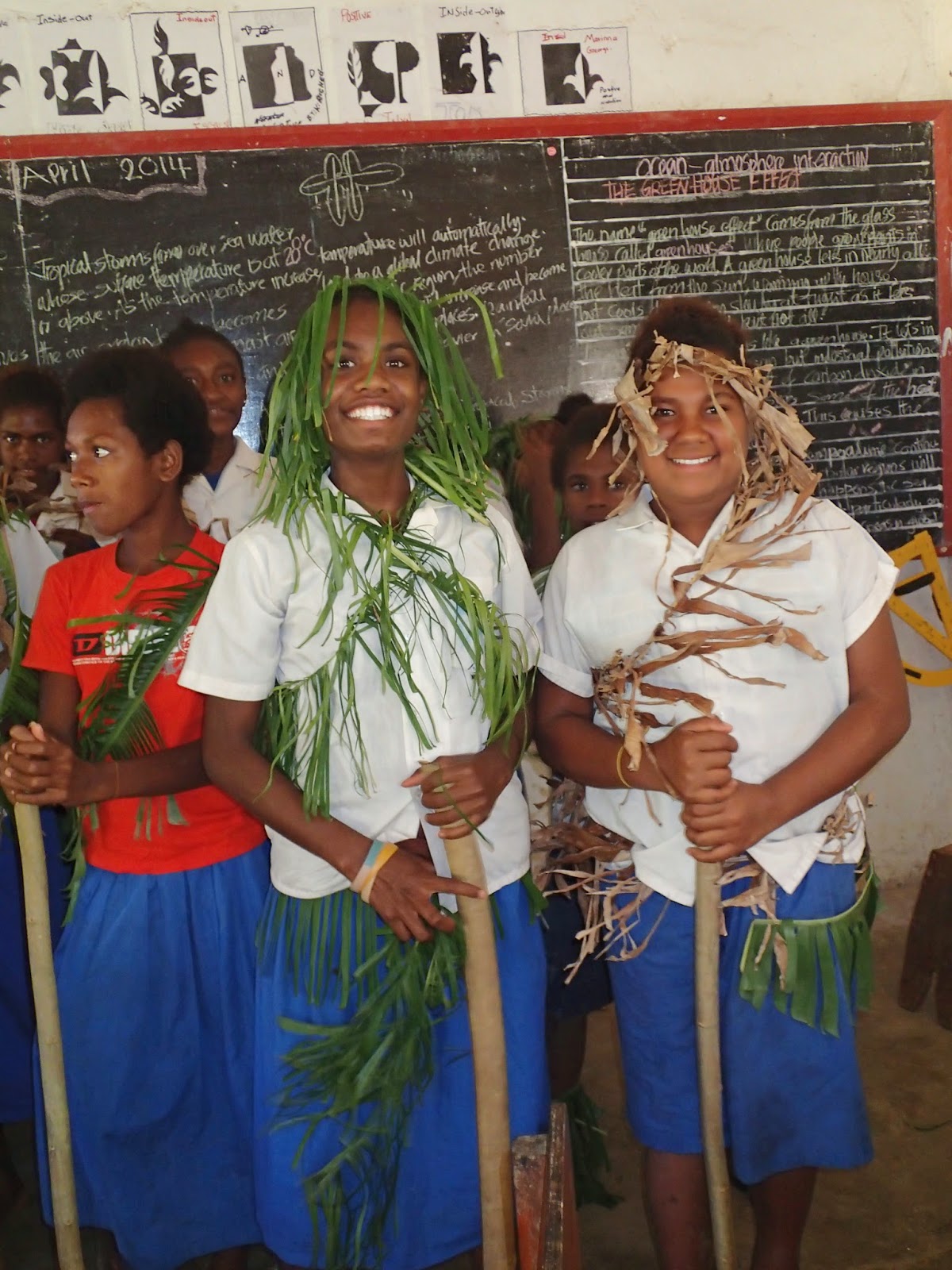
Class 6 doing kastom
One of Class 6's units is about kastom. They read stories about kastoms from other islands and they're encouraged to explore their own kastom.
I would say that Tongariki is not a kastom island but that people still practice their kastom. We do do some kastom dancing and there's still kastom for weddings, deads, new babies, and so on, but without some of the other taboos that are common in different parts of Vanuatu. (Woman Atong drinks kava and can cook while she's on her period, for example. Also while it's respectful to call everyone Mami, Uncle, Tawi, you can use their names. In some places, certain relationships have taboos, such that instead of talking about Auntie Lewi or Mama Dora, you talk about Auntie Santo and Mami Pis Kops.)
At my school, I would say they do a good job of teaching the kids their kastom. They do a kastom show every year and they practice doing cultural activities about one afternoon a month, more around the time of the show. The kids on Tongariki know how to make mats, how to do basic carvings, and they know their dances.
[Rinnie and Ryana]
Obviously, this isn't normal kastom wear ... but on Tongariki, from what I've seen, this part is pretty legitimate. Last year during Independence, everyone who was dancing put bunches of leaves around themselves and we were painting ourselves with chalk and ashes from the fire. I think it's more just to make style, really--because like I said, we're not kastom like that so in a sense, it is like putting on a costume.
Tuesday, July 1, 2014
Traveling is fun fun fun
Traveling in Vanuatu is hilarious. It’s always kind of
unpleasant and nothing is secure unless you are on the plane and it’s taxi-ing
down the runway. Even ships, if you’re on them, they can change the routine,
and be like, oh sori, we’re actually going to do this other thing first. It can
be pretty stressful to travel if you have a set date you have to get somewhere
else by. But if you have a lot of free time, it’s kind of fun. I think if you
had enough money and felt like you had the freedom to say “I’m going to a
northern island and I’ll get there when I get there,” you’d have a good time. I actually fantasize about that sometimes, imagining the time and the money to go all over the Pacific, seeing everything over the course of a few years. Kind of like Paddling the Pacific by Paul Theroux, but on a longer time frame.
I’ve been trying to get to Ambrym to do a workshop and walk
around a little. People in Vanuatu think that Ambrym is full of black magic,
and I was told by an auntie to look after my food while I’m there, so no man
Ambrym can put a love potion in. (She said it in a joking tone but it’s still
like, whoa, that’s your advice.) They also have some really nice kastom things.
They do really nice wood carvings, making these figures that are called
tamtams. In Vila, and on Ambrym, too, you can buy these little ones, maybe the
height of your hand to the length of your arm. But in kastom for men who are
taking different chiefly ranks, there are special ways to carve them and they
can be really, really big. In the Cultural Center here in town they have a few
tamtams that are just enormous.
[Insert picture of the tamtam with me and my parents.]
So what’s complicated is this. I’m trying to travel north
with Jessica (another vol) out of Vila. There’s Michelle, who’s trying to meet
us out of Epi. So we need to leave Vila, hit Epi, and then get to Ambrym—three points
on our travel.
Over the weekend, when we called the office, they told us that the ship would definitely go Vila-Epi-Ambrym. On Sunday, the crew told us that, kiaman, the ship would definitely go direct to Santo, in the north, do not pass go, do not collect 200 dollars. On Monday, we called the ship and they told us that they were definitely still going Vila-Epi-Ambrym and that they would be out that night. But around mid-day, they told us that it would be delayed until Tuesday. Yesterday, we put our stuff on the ship and bought tickets, and got told that the ship would Vila-Epi-Ambrym out at 8. We got so prepped; I got 500 vatu of kava and two Solbrews, calamari from Island Time, bread and butter and pate and cookies. Then we got to the wharf and … No gat. The ship’s now supposed to be out tonight at 6.
A volunteer who lives in town was really nice and let us all crash over at his place last night. We went out, drank a little kava, ate our dinners, rolled out in the morning. God willing, I will leave Efate tonight. But you know ... it's not the end of the world if it doesn't work. I'll get a refund and I'll go do something else. I do have to be back in Vila on July 14th because I have an international plane ticket -- awo.
Subscribe to:
Posts (Atom)